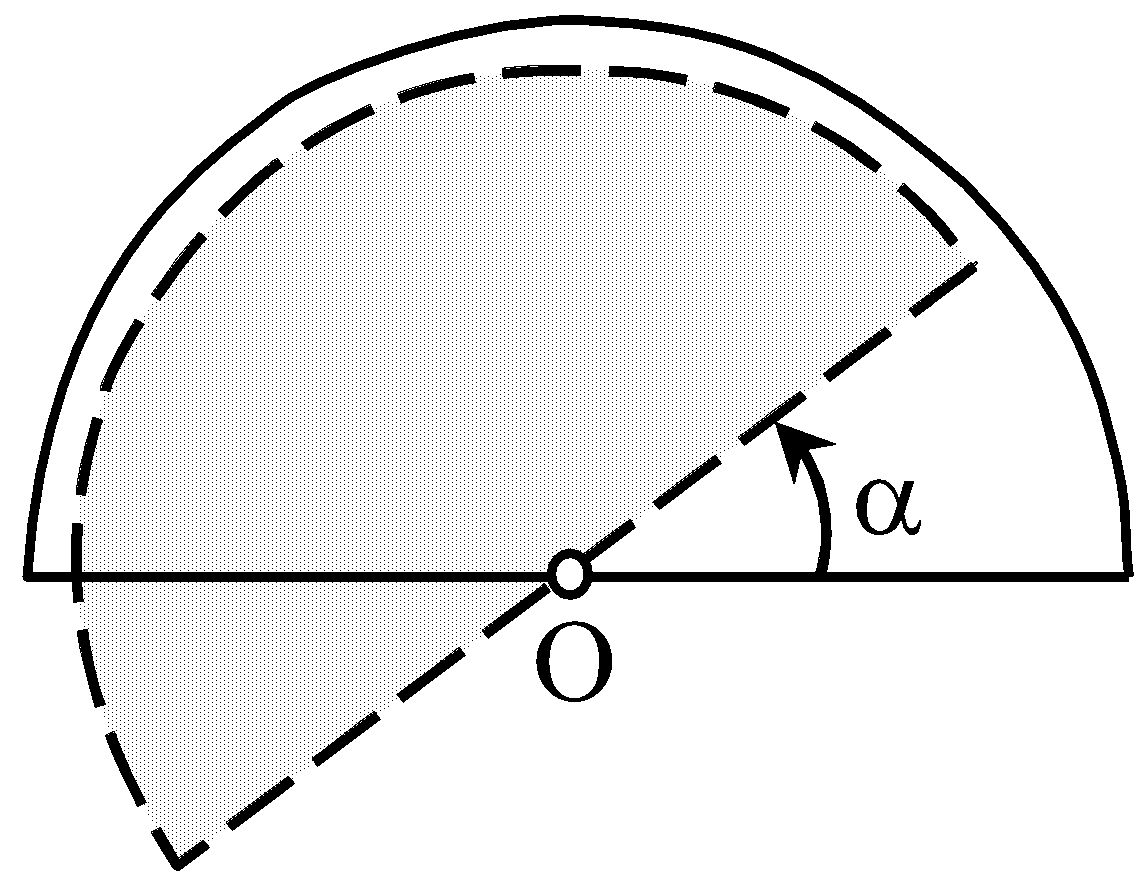
A capacitor consists of two fixed plates in the form of a semicircle of radius R and a movable plate of thickness h made of a dielectric with the dielectric constant ε, placed between them. The latter plate can freely rotate about the axis O (Fig.) and practically fills the entire gap between the fixed plates. A constant voltage U is maintained between the plates. Find the moment M about the axis O of forces acting on the movable plate when it is placed as shown in the figure.
Text Solution
Verified by ExpertsC
Sol. The work performed by the moment of forces M upon the rotation of the plate through an angle element dα is equal to the decrease in the electric energy of the system at q = const:
M Z dα = – dW | q ,
where W = q 2 /2C. Hence
M z = –  =
= 
 . .... (1)
In the case under consideration, C = C 1 + C e , and C e are the capacitances of the parts of the capacitor with and without the dielectric. The area of a sector with an angle α is determined as S = αR 2 /2, and hence
C = ε 0 αR 2 /2h + εε 0 (π – α) R 2 /2h.
Differentiating with respect to α, we find ∂ C/ ∂ α = (ε 0 R 2 /2h) (1 – ε). Substituting this expression into formula (1) and considering that C = q/U, we obtain
M z = 
 (1 – ε)
= – (ε – 1)  < 0.
< 0.
The negative sign of M z indicates that the moment of the force is acting clockwise (oppositely to the positive direction of the angle α; see Fig.). This moment tends to pull the dielectric inside the capacitor.
It should be noted that M z is independent of the angle α. However, in equilibrium, when a = 0, the moment M z = 0.
Prepare Smarter with CGP Edu
Get practice questions, solutions, and test series in one place.
Write a Review
Share your experience with this question and solution.
Commentary
Send your comment, doubt, correction, or feedback to admin.
Similar Questions
Explore conceptually related problems